Socials


.jpeg)
A calorie is often treated as a simple unit of energy, interchangeable regardless of its source. On paper, 200 calories from a smoothie and 200 calories from whole fruit appear identical. But the human body does not operate on paper. It responds to structure, texture, digestion time, and the signals generated during eating. Liquid calories, whether from juices, smoothies, or sweetened beverages, interact with hunger, satiety, and metabolism in ways that differ meaningfully from solid foods. Understanding this difference reveals why many people can consume large amounts of energy without feeling full, and why calorie balance alone does not always predict real world outcomes.
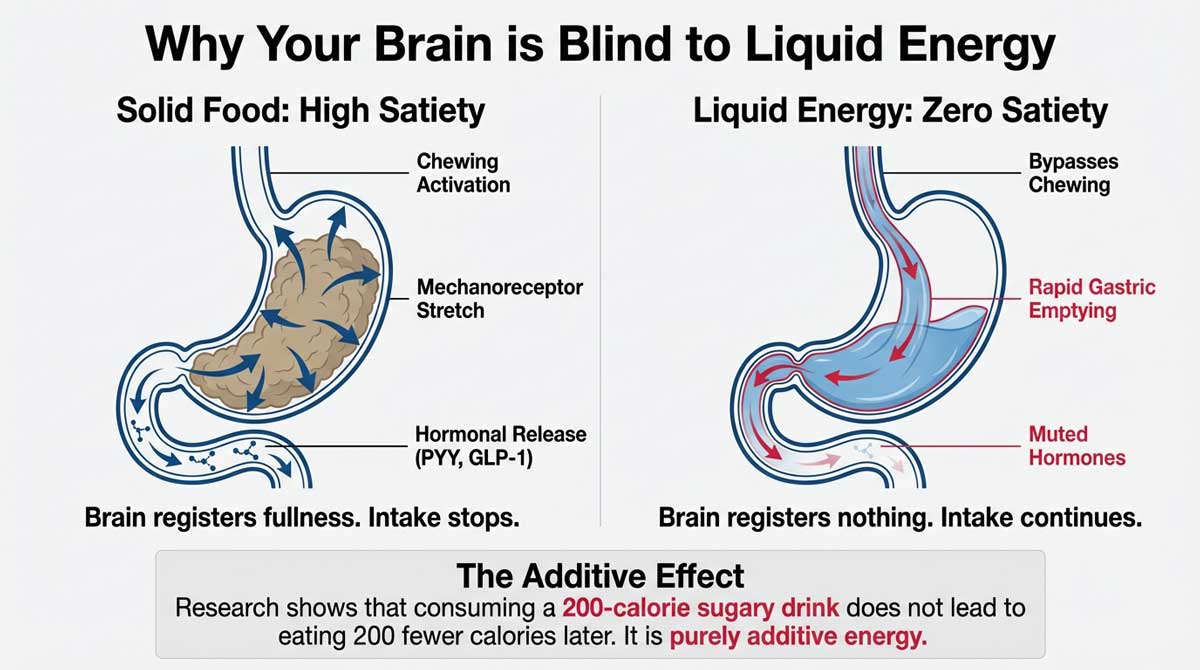
When you eat solid food, the process begins before nutrients even enter the bloodstream. Chewing slows intake, activates sensory pathways, and initiates hormonal responses linked to fullness. Signals from the gut, including hormones such as GLP 1 and peptide YY, help regulate appetite and communicate to the brain that energy is being consumed (Mattes and Campbell, 2009). This process takes time, allowing the body to calibrate intake based on internal feedback.
Liquid calories bypass many of these steps. They require little to no chewing, are consumed quickly, and pass through the stomach faster than solid foods. This reduces the strength and duration of satiety signals. As a result, the body often fails to fully register liquid calories as a complete intake event.
A common assumption is that the body will naturally compensate later by reducing hunger. In practice, this compensation is often incomplete. Studies show that calories consumed in liquid form are less effectively offset by reduced intake at subsequent meals, leading to a higher total daily energy intake (DiMeglio and Mattes, 2000).
One of the most important differences is speed. Drinking calories is faster than eating them. This reduces awareness and increases the likelihood of passive overconsumption. A smoothie or juice can be consumed in minutes, delivering hundreds of calories before the body has time to respond with fullness signals.
There is also a structural difference. Whole foods contain fiber and intact cellular structures that slow digestion and prolong satiety. When foods are blended or juiced, this structure is partially broken down. Even when fiber is technically present, as in smoothies, the physical form changes how quickly nutrients are absorbed and how the body responds.
However, it is worth challenging an oversimplified conclusion. Not all liquid calories behave the same way. A protein rich shake with fiber and fat may produce more satiety than a sugar sweetened beverage. The issue is not simply liquid versus solid, but how the food matrix, nutrient composition, and processing level interact. Still, across typical dietary patterns, liquid calories tend to be less regulating than solid ones.
.png)
Another layer to consider is behavioral. Liquids are often consumed outside of structured meals. Coffee drinks, juices, and flavored beverages are treated as additions rather than replacements. This creates a stacking effect where calories accumulate without triggering the same psychological recognition as eating a meal.
This challenges the belief that awareness alone is enough to regulate intake. Even when people know they are consuming calories, the absence of strong physiological satiety signals makes it difficult to adjust later intake accurately. Over time, this can contribute to a consistent energy surplus without a clear perception of overeating.
Research has consistently shown that beverages, particularly sugar sweetened ones, are associated with increased total energy intake and weight gain risk, partly because they do not elicit the same compensatory reductions in food intake (Malik et al., 2013). The body treats them differently, and behavior amplifies that difference.
It would be too simplistic to conclude that all liquid calories are harmful or should be avoided. There are contexts where they are useful. For individuals with high energy demands, such as athletes, liquid calories can provide a convenient way to meet intake needs without excessive fullness. For those with reduced appetite or medical conditions, they can help maintain adequate nutrition.
The key distinction is intention. When liquid calories are used deliberately as a tool, they can be beneficial. When they are consumed passively, as part of daily habits without awareness, they often lead to unintended consequences.
This reframes the issue from good versus bad to appropriate versus misaligned. The same smoothie that supports recovery after intense training may undermine energy balance if consumed casually alongside regular meals.
Rather than focusing only on calorie numbers, it is more effective to consider how a food or drink influences satiety, awareness, and total intake. Whole fruits, vegetables, and minimally processed foods tend to create stronger fullness signals and slower energy release. These characteristics support better appetite regulation over time.
If consuming liquid calories, treating them as a meal rather than an addition can improve alignment. A smoothie that replaces breakfast is different from a smoothie added on top of breakfast. Including protein, fiber, and some fat can also enhance satiety and reduce rapid spikes in blood sugar.
From a broader perspective, this highlights a limitation in traditional calorie based thinking. Energy balance is not just about arithmetic. It is about how the body perceives and responds to intake. Structure, timing, and context all influence outcomes.
Liquid and solid calories are not metabolically equivalent in practice. Liquids are processed faster, generate weaker satiety signals, and are less likely to trigger compensatory reductions in later intake. This makes them easier to overconsume, especially when they are integrated into daily routines without intention.
At the same time, liquid calories are not inherently harmful. Their impact depends on how and why they are used. By prioritizing whole foods, being mindful of liquid intake, and aligning consumption with actual needs, it becomes easier to regulate appetite and maintain energy balance.
The difference is not just in the calories themselves, but in how the body experiences them.
DiMeglio, D. P. and Mattes, R. D. (2000) ‘Liquid versus solid carbohydrate: effects on food intake and body weight’, International Journal of Obesity, 24(6):794 to 800. https://doi.org/10.1038/sj.ijo.0801229
Malik, V. S., Pan, A., Willett, W. C. and Hu, F. B. (2013) ‘Sugar sweetened beverages and weight gain in children and adults’, The American Journal of Clinical Nutrition, 98(4):1084 to 1102. https://doi.org/10.3945/ajcn.113.058362
Mattes, R. D. and Campbell, W. W. (2009) ‘Effects of food form and timing of ingestion on appetite and energy intake in lean young adults’, Journal of the American Dietetic Association, 109(3):430 to 437. https://doi.org/10.1016/j.jada.2008.11.031



.png)


