Socials


Most runners think about distance, pace, or shoes. Form often gets ignored because it feels technical or hard to change. But how you move shapes where force goes in your body, how efficiently you run, and how likely you are to get hurt. There is no single perfect running style. The goal is to make small adjustments that improve comfort, reduce unnecessary strain, and support consistent training.

Every step you take sends force through your feet, ankles, knees, hips, and spine. Running form determines how that force is distributed. When mechanics are off, certain tissues take more load than they can handle, especially as mileage builds.
Form also affects energy use. Inefficient patterns waste energy through extra vertical bounce, braking forces, or unnecessary muscle tension. Over time, this can slow you down and make runs feel harder than they should.
The key idea is simple. Good form is not about looking a certain way. It is about managing load and using energy well.
If you often feel knee pain
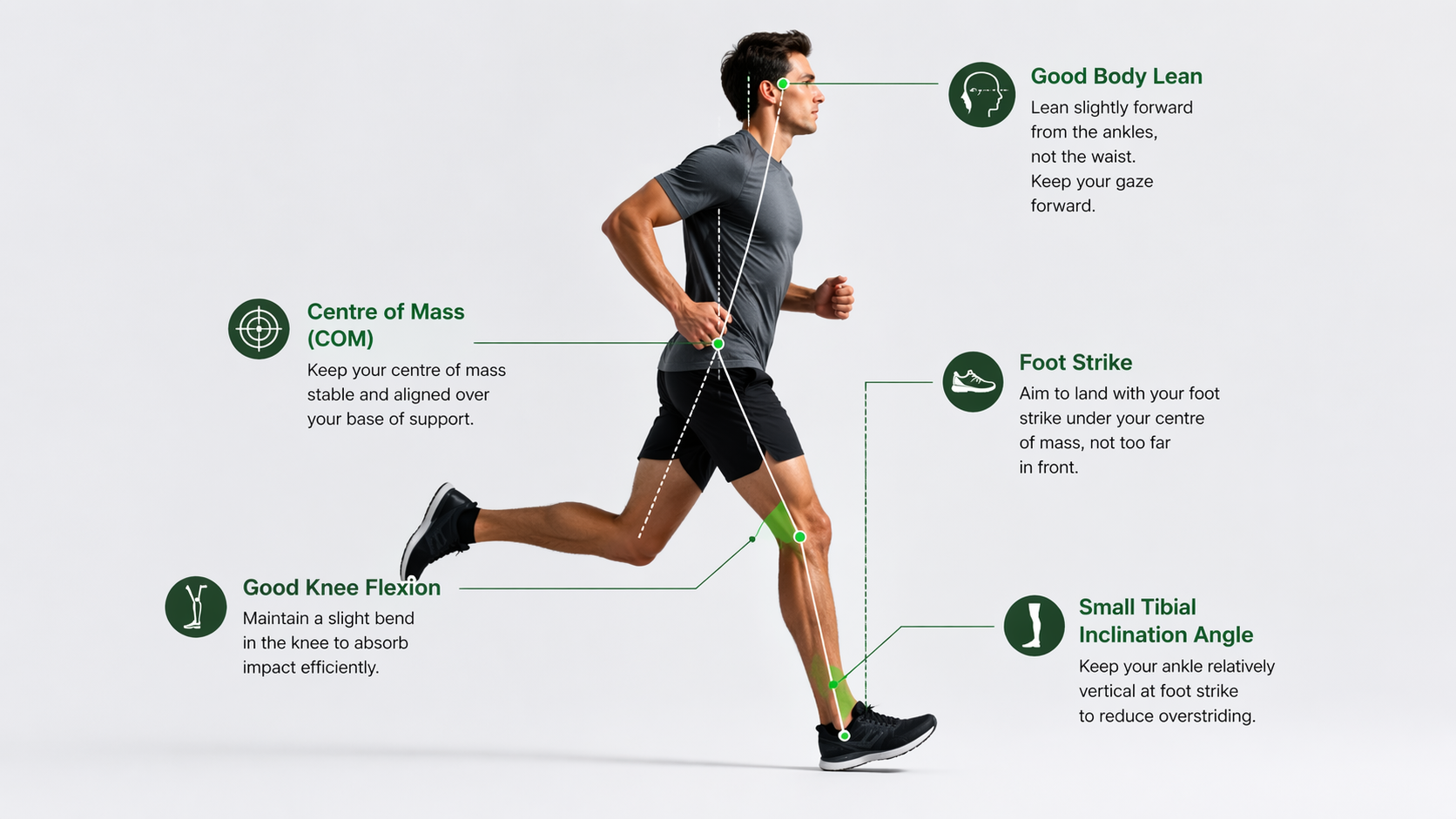
Look at overstriding. Landing too far in front of your body increases braking forces and stress at the knee. A slightly shorter stride with your foot landing closer to your center of mass can help shift load more evenly.
If your calves or Achilles get tight or sore
You may already be landing more on the midfoot or forefoot. This can be efficient, but it increases demand on the calf complex. Build strength gradually and avoid sudden changes in stride or footwear.
If you feel heavy or slow
Check your cadence. A slightly higher step rate often reduces impact per step and smooths your stride. Many runners benefit from a small increase rather than a big change.
If you struggle with posture late in runs
Focus on a tall, relaxed position. Think of a gentle forward lean from the ankles, not the waist, with your head over your shoulders and shoulders over your hips.
Heel striking, midfoot striking, and forefoot striking are often treated like strict categories. In reality, they exist on a spectrum, and none is automatically right or wrong.
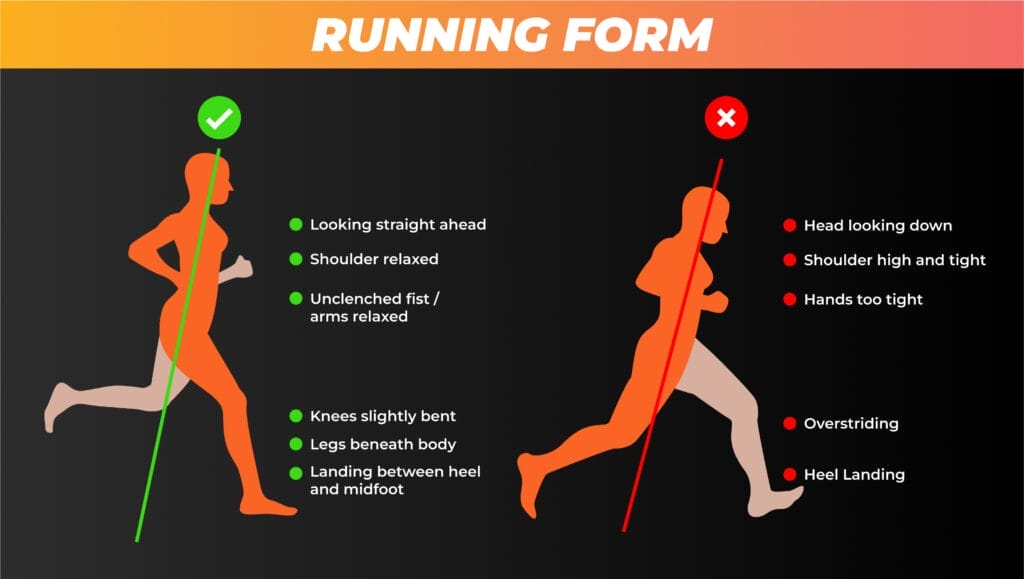
Heel striking is common, especially at easier paces. It is not inherently harmful, but when combined with overstriding it can increase braking forces.
Midfoot and forefoot patterns can reduce that braking effect and feel smoother for some runners. However, they place more load on the calves and Achilles tendon.
Instead of trying to force a specific foot strike, it is usually more effective to adjust where your foot lands relative to your body. A quieter, more controlled landing under your center of mass often improves mechanics naturally.

Cadence refers to how many steps you take per minute. Stride length is how far you travel with each step. These two always work together.
A very long stride often leads to overstriding and higher impact forces. A very short stride can feel choppy and inefficient. The balance is personal, but many runners improve by slightly increasing cadence and letting stride length adjust naturally.
Even a small increase in cadence can reduce peak load on joints without making running feel forced. Think light, quick steps rather than pushing harder into the ground.
Your upper body sets the tone for everything below it. A slouched posture can restrict breathing and shift load to the hips and knees. Excessive tension in the shoulders or arms wastes energy.
Aim for a relaxed, upright position. Keep your gaze forward, shoulders loose, and arms swinging naturally at your sides. Your hands do not need to cross your body or clench tightly.
A simple check is this. If your upper body feels tense, your lower body is likely working harder than it needs to.
Running is a series of controlled falls. Each time your foot hits the ground, your body absorbs and redirects force.
Two useful cues are
Land softly and quietly
Push the ground behind you, not in front of you
A loud, heavy landing often signals excess impact or overstriding. A smoother contact usually means forces are being absorbed and reused more effectively.
Start with awareness
Notice how your feet land, how your body feels, and where tension builds during a run. Short video clips can help you see patterns you do not feel.
Make one change at a time
Small adjustments are more sustainable. For example, increase cadence slightly or focus on landing closer to your body.
Use short practice blocks
Test changes during easy runs for a few minutes at a time. Let your body adapt gradually rather than forcing a new style for an entire run.
Build strength alongside form work
Strong calves, hips, and core muscles support better mechanics. Without strength, form changes are harder to maintain.
Stay patient
Your body needs time to adapt. Sudden, large changes can increase injury risk instead of reducing it.
If you have recurring injuries, form is worth a closer look. Pain in the same area often reflects repeated stress in a specific pattern. A clinician or running specialist can help identify what is happening and guide changes safely.
If you are increasing mileage or intensity, this is also a good time to refine form. As training load rises, small inefficiencies become more noticeable.
Running form shapes how force moves through your body and how efficiently you use energy. You do not need a perfect style. Focus on small, practical changes like landing closer to your body, keeping steps light, and maintaining a relaxed posture. These adjustments can reduce injury risk and make running feel smoother over time.
Heiderscheit BC, Chumanov ES, Michalski MP et al. 2011 Effects of step rate manipulation on joint mechanics during running. Medicine and Science in Sports and Exercise 43(2):296–302. https://doi.org/10.1249/MSS.0b013e3181ebedf4
Lieberman DE, Venkadesan M, Werbel WA et al. 2010 Foot strike patterns and collision forces in habitually barefoot versus shod runners. Nature 463:531–535. https://doi.org/10.1038/nature08723
Saunders PU, Pyne DB, Telford RD et al. 2004 Factors affecting running economy in trained distance runners. Sports Medicine 34(7):465–485. https://doi.org/10.2165/00007256-200434070-00005
van der Worp MP, ten Haaf DSM, van Cingel R et al. 2015 Injuries in runners a systematic review on risk factors and sex differences. PLoS One 10(2):e0114937. https://doi.org/10.1371/journal.pone.0114937